
Only 9% of CEOs polled fear the GDP growth rate will slip any further to below 4% while 46% said it would remain in the 4-5% range.
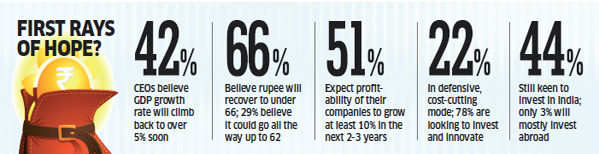
Indian chief executives, who have been struggling to cope with an unrelenting slowdown over the past two years and battered by a rupee in free fall, are showing the first, faint signs of optimism. In an 'ET CEO Confidence Survey' of the country's 100 top business leaders, 42% were brave enough to predict a minor uptick in the GDP growth rate — from 4.4% recorded in the first quarter of FY13 to over 5% this year and the next.
Growth slumped to a decade-low 5% in the year ended March. Any recovery, however minor, seemed improbable even last fortnight, when HSBC, JPMorgan, Nomura and Goldman Sachs, among others, slashed India's growth forecast to the 4-4.2% range. "I do not think it (the economic situation) is going to get worse than this," says Ajay Piramal, chairman of the Piramal group. He's optimistic that GDP growth could climb back to over 6% if the economy is managed well.
Only 9% of CEOs polled fear the GDP growth rate will slip any further to below 4% while 46% said it would remain in the 4-5% range. Almost two-thirds of CEOs interviewed also believe the rupee will recover, and strengthen past 66 to the dollar one year from now. Twentynine per cent even went to the extent of saying the currency will be stronger than 62 to the dollar. This is a fairly bold consensus, given that the rupee depreciated sharply — from 61.25 to the dollar all the way down to 69 — during the fortnight in which a bulk of the interviews for this survey was conducted.
The optimism on GDP and currency fronts, coupled with the investment plans and profit expectations from their respective businesses that the CEOs shared in the survey, suggests that large swathes of India Inc now believe that the worst is probably over. But is this optimism warranted? "Frankly, I think the question should be what drove this exaggerated pessimism over the last three months in the first place," answers Janmejaya Sinha, chairman, Asia-Pacific, Boston Consulting Group (BCG).
Growth slumped to a decade-low 5% in the year ended March. Any recovery, however minor, seemed improbable even last fortnight, when HSBC, JPMorgan, Nomura and Goldman Sachs, among others, slashed India's growth forecast to the 4-4.2% range. "I do not think it (the economic situation) is going to get worse than this," says Ajay Piramal, chairman of the Piramal group. He's optimistic that GDP growth could climb back to over 6% if the economy is managed well.
Only 9% of CEOs polled fear the GDP growth rate will slip any further to below 4% while 46% said it would remain in the 4-5% range. Almost two-thirds of CEOs interviewed also believe the rupee will recover, and strengthen past 66 to the dollar one year from now. Twentynine per cent even went to the extent of saying the currency will be stronger than 62 to the dollar. This is a fairly bold consensus, given that the rupee depreciated sharply — from 61.25 to the dollar all the way down to 69 — during the fortnight in which a bulk of the interviews for this survey was conducted.
The optimism on GDP and currency fronts, coupled with the investment plans and profit expectations from their respective businesses that the CEOs shared in the survey, suggests that large swathes of India Inc now believe that the worst is probably over. But is this optimism warranted? "Frankly, I think the question should be what drove this exaggerated pessimism over the last three months in the first place," answers Janmejaya Sinha, chairman, Asia-Pacific, Boston Consulting Group (BCG).
 |
Raghuram Rajan's swashbuckling start as RBI governor on Wednesday has edged out some of the "exaggerated pessimism" that BCG's Sinha is referring to. The bulk of the survey, though, was completed before Rajan took over on Wednesday. On Thursday, the BSE Sensex soared more than 400 points and the rupee shot up 1.6% in an obvious turnaround of sentiment. "The worst is over for the rupee," Piramal says. CEOs also seem to be taking a measured view of currency and stock market volatility.
At a time the rupee has been extraordinarily weak, business heads haven't been swayed by it. Continuing infrastructure bottlenecks, policy ambiguity and lack of reforms, they said, were bigger challenges than a weak currency. "Yes, there is volatility, but fundamentally I think India is in a much stronger place today," says Sonjoy Chatterjee, chairman, Goldman Sachs India.
0 comments:
Post a Comment